

What do the Ten Commandments mean to you?
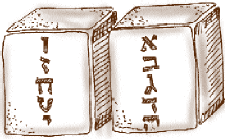 Sure, we hear about it on the news every so often when there is a dispute about a plaque with the Ten Commandments in some court, and of course we know it is a big part of Jewish History. But have you ever thought about what 10 commandment mean to you personally in the 21st century?
Perhaps by looking a little closer at the Ten Commandments we will be able to see some sort of structure as to what the eternal message of some of the most important ingredients of living a just, meaningful and Jewish oriented life.
Looking at the Ten Commandments, there is the obvious first commandment which would seem to be a prerequisite to all other commandments, “believing in G-d”. Interestingly, believing in G-d is not taken as a given and obvious matter, rather it is an actual commandment and Mitzvah. This means that Judaism is telling us that “belief in G-d” is something that needs to be cultivated and developed even if it is challenging sometimes. Expecting it be there automatically is not a Jewish approach and it isn’t necessarily going to work.
Judaism teaches us that innately, we are all predisposed to a belief in a higher power and in G-d, but at the same time, we function in a world society and in a manner where this internal belief is not at the forefront of our thinking. Instead it might negated, concealed or simply swept under the rug of our existence and busy lives.
Thus, the very first commandment that the Torah gave us, is to actually work on our belief and to cultivate and inoculate this idea in our minds. The Torah does not say that this is an easy task, it may be difficult and challenging, but it needs to get done. Developing this could be done through study, reflection and mediation on this idea, so that it becomes central to who we are and how we think.
Judaism says that the first commandment along with the second commandment “of not having any foreign G-d’s or doing things that will make G-d “unhappy””, are the two most basic commandments that a Jew should believe in. Those then become the foundation of our belief system and will be the basis of our desire to adhere to the rest of the commandments including all of the very important commandments that impact relationships between people and caring for those around us.
The Fourth & Fifth Commandments
After one more commandment about how we treat G-d and his name, the Torah then moves into two more commandments that actually help strengthen the ideals of the first. The fourth commandment talks about the importance of observing and celebrating Shabbat, since by doing so it helps us step back from the rush of life and recognize the bigger picture of the world and its purpose, and appreciate why we are here.
Then the fifth commandment talks about how important respecting our parents is, and it is something that remains eternally true and not dependent on our whims, grudges or moods. Yet in a certain sense, by making a Mitzvah out of respecting and appreciating those who brought us into the world to begin with, it also helps us take this a step further and recognize what helped bring our parents into being and what force brought the world into existence.
Thus the 4th and 5th commandments are very much part of strengthening our belief in G-d.
Why the Simple Commandments?
Then come the final commandments of “You shall not murder”, "You shall not commit adultery”, etc.
These are seemingly important yet logical commandments that we would probably have thought up by ourselves and are in fact dear to any sane and normal society.
Yet by inserting these commandments into the biggest moment of Jewish history and into the same moment when they are told just how important belief in G-d is, a powerful message is being conveyed. Judaism is telling us that our moral values and compass are powerful and sustainable when they are rooted and bound up in their Divine origins. When murder, stealing, adultery, charity and honesty are values that we don’t do simply because we feel right about them, rather we do them because they are Divine and eternally true, then our value system that we adhere to is much more likely to hold for the long term. In addition, it is also less likely to be corrupted for reasons, causes or factors that can be used to justify modification to those critical values of life.
One only needs to look to modern history where some of the most civil societies in the world became the most depraved in the world, yet at the same time they convinced themselves that they were doing a favor and good deed for themselves and mankind by killing Jews and others they disliked. Morality with no true compass or anchor, can easily be misused or lead to the opposite of good
Thus to summarize the Roadmap of the 10 Commandments is almost a three step process;
1. Cultivate and develop our belief in G-d.
2. Do things that will strengthen the belief like honoring parents and celebrating Shabbat.
3. Ensure that our basic values and morals are rooted in the G-dly system from which they should originate.
Doing all of the above, while not guaranteeing perfection as we will always be human, will nevertheless go a long way in ensuring that the values of Judaism are a part of our lives and the way we live, as well as the lives of the children that we raise and educate.
Good Shabbos
Yisroel